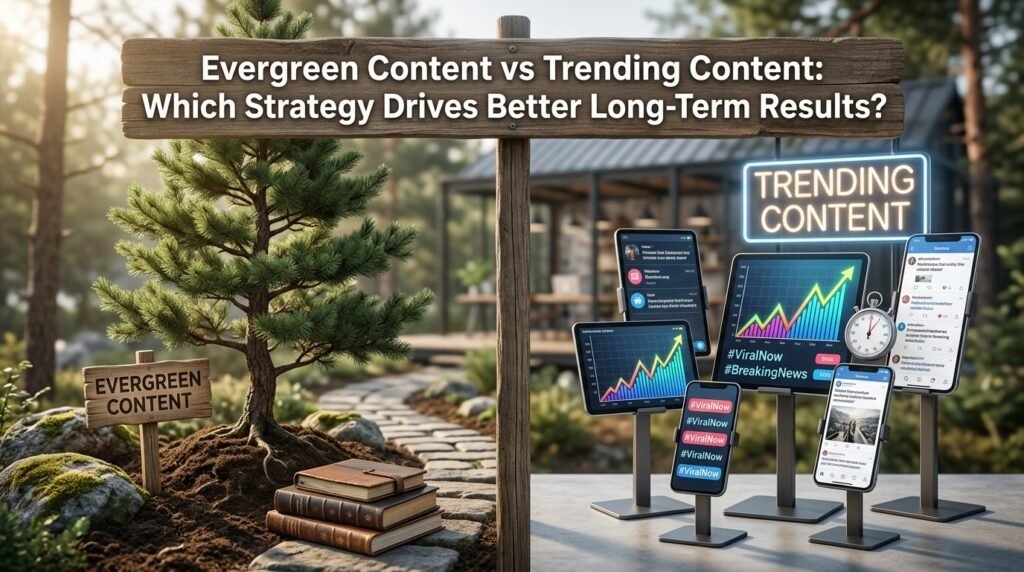
A successful content marketing strategy doesn’t rely solely on evergreen or trending content. Instead, businesses achieve the strongest long-term results by combining both.
Evergreen content generates consistent organic traffic, strengthens topical authority, and supports long-term SEO growth. Trending content captures immediate attention, increases social engagement, and helps brands stay relevant during periods of heightened search interest.
Understanding when to use each content type enables businesses to build sustainable traffic while capitalizing on timely opportunities that boost visibility and audience engagement.
Should you create evergreen content or trending content?
Both. Evergreen content builds long-term search visibility, attracts consistent organic traffic, and strengthens SEO over time. Trending content generates immediate attention, increases social engagement, and helps businesses capitalize on current events and industry developments. The most effective content strategies typically combine both, using evergreen content as the foundation and trending content to maintain relevance and capture new audiences.
Why Content Lifespan Matters More Than Most Marketers Realize
Many businesses focus exclusively on publishing more content.
The real question isn’t:
“How much content are we publishing?”
It’s:
“How long will this content continue generating value?”
Some articles disappear from search results within weeks.
Others continue attracting traffic, leads, and backlinks for years.
Understanding this difference is one of the biggest competitive advantages in modern SEO.
The Two Types of Search Demand
Every search query generally falls into one of two categories.
Consistent Search Demand
Topics people search every month.
Examples:
- What is SEO?
- Email marketing guide
- Local SEO checklist
- How to build a website
These become evergreen opportunities.
Temporary Search Demand
Topics driven by:
- Breaking news
- Algorithm updates
- Product launches
- AI announcements
- Industry trends
- Seasonal events
Interest rises rapidly.
Then gradually disappears.
Understanding search demand helps marketers decide which content deserves long-term investment.
Evergreen vs Trending: The Traffic Psychology
Evergreen and trending content behave differently because people search for them differently.
Evergreen searches are driven by persistent problems.
Trending searches are driven by immediate curiosity.
Examples:
Evergreen:
“How to improve SEO”
Trending:
“Google June Core Update”
One answers an ongoing need.
The other answers a current event.
Successful content strategies satisfy both.
Content Lifecycle Explained
Every article follows a lifecycle.
Understanding that lifecycle helps marketers prioritize content investments.
Evergreen Content Lifecycle
Publish
↓
Gradual Ranking
↓
Traffic Growth
↓
Authority Growth
↓
Backlinks
↓
Consistent Monthly Traffic
↓
Periodic Updates
↓
Continued Rankings
Evergreen content often improves over time.
Trending Content Lifecycle
Publish
↓
Traffic Spike
↓
Social Shares
↓
High Visibility
↓
Search Interest Declines
↓
Traffic Drops
↓
Archive or Refresh
Trending content moves much faster.
Content Lifecycle Comparison
| Evergreen Content | Trending Content |
|---|---|
| Slow initial growth | Rapid traffic spike |
| Long lifespan | Short lifespan |
| Stable rankings | Temporary rankings |
| Ongoing SEO value | Immediate visibility |
| Builds authority | Builds awareness |
Neither is inherently better.
Each serves a different marketing objective.
Why Google Rewards Evergreen Content
Google’s mission is to provide users with the most helpful answers.
Many evergreen topics continue satisfying user intent for years.
Examples include:
- SEO basics
- Email marketing
- Website optimization
- Content strategy
- Keyword research
These topics remain valuable regardless of the year.
Google often rewards comprehensive evergreen resources with:
✔ Stable rankings
✔ Featured Snippets
✔ AI Overview citations
✔ Backlinks
✔ Consistent impressions
Why Trending Content Still Matters
Despite its shorter lifespan, trending content plays a vital role.
Publishing quickly helps businesses:
- Join industry conversations.
- Demonstrate expertise.
- Capture sudden search demand.
- Increase social visibility.
- Attract first-time visitors.
Many users discover brands through trending content before exploring evergreen resources.
The Biggest Content Marketing Myth
Some marketers believe:
“Evergreen content is always better.”
Others argue:
“Trending content generates more traffic.”
Both statements are incomplete.
A successful content strategy depends on:
- Business goals.
- Industry.
- Audience behavior.
- Marketing resources.
- Publishing frequency.
The real objective isn’t choosing one over the other.
It’s building the right balance.
What is the difference between evergreen content and trending content?
Evergreen content remains relevant and valuable for months or years, generating consistent organic traffic and supporting long-term SEO. Trending content focuses on current events or popular topics, producing immediate traffic and social engagement but typically experiencing a shorter lifespan. A balanced content strategy uses both to maximize long-term growth and short-term visibility.
The Hidden Business Value of Evergreen Content
Many companies underestimate how valuable one high-quality evergreen article can become.
A comprehensive guide may:
- Rank for hundreds of keywords.
- Earn backlinks naturally.
- Generate leads continuously.
- Support internal linking.
- Strengthen topical authority.
One excellent evergreen article can outperform dozens of short-lived news posts over several years.
Why Businesses Chase Trends
Trending content offers something evergreen rarely delivers immediately:
Momentum.
A well-timed article can:
✔ Generate rapid website traffic.
✔ Increase social shares.
✔ Earn media attention.
✔ Build brand awareness.
✔ Introduce new audiences to your business.
When combined with strong internal linking, trending visitors often transition into readers of evergreen resources.
Professional Content Strategy Insight
The highest-performing content strategies rarely rely exclusively on evergreen or trending topics.
Instead, successful businesses build an ecosystem.
Evergreen content establishes authority and generates predictable organic traffic, while trending content creates visibility, attracts new audiences, and demonstrates industry relevance.
Together, they create a sustainable content engine that delivers both immediate engagement and long-term SEO growth.
Evergreen Content: The Foundation of Long-Term SEO
If your website were a house, evergreen content would be its foundation.
It’s the content that continues attracting visitors long after it’s published, making it one of the most valuable assets in any digital marketing strategy.
Unlike time-sensitive posts, evergreen articles answer questions people search for every day.
Whether someone searches today or two years from now, the information remains useful.
That lasting relevance is why evergreen content often becomes the backbone of sustainable organic growth.
What Makes Content Truly Evergreen?
Not every educational article is evergreen.
High-performing evergreen content usually has five characteristics:
1. Timeless Value
It solves problems that don’t disappear with time.
Examples:
- How to perform keyword research
- Local SEO guide
- Email marketing best practices
2. Consistent Search Demand
People search for the topic every month.
Instead of depending on news cycles, it serves recurring user intent.
3. Comprehensive Coverage
Evergreen content answers multiple related questions within one resource.
This increases:
- Topical authority
- User satisfaction
- Time on page
- Internal linking opportunities
4. Easy to Refresh
Statistics, screenshots, and examples can be updated without rewriting the entire article.
5. Supports Multiple Keywords
A strong evergreen article rarely ranks for only one keyword.
It often ranks for:
- Primary keywords
- Long-tail keywords
- Semantic phrases
- People Also Ask queries
Why Evergreen Content Dominates SEO
Google prefers content that continues satisfying user intent.
Evergreen resources naturally accumulate:
✔ Backlinks
✔ Authority
✔ Internal links
✔ Organic traffic
✔ Brand trust
Each passing month often strengthens their ranking potential.
Evergreen SEO Lifecycle
Month 1
↓
Google Indexing
↓
Initial Rankings
↓
Traffic Growth
↓
Backlinks
↓
Authority Growth
↓
Keyword Expansion
↓
Stable Long-Term Rankings
Evergreen content behaves like a long-term investment rather than a short campaign.
Evergreen ROI Timeline
| Time After Publishing | Typical Performance |
|---|---|
| Month 1 | Low traffic while indexing |
| Months 2–3 | Rankings begin improving |
| Months 4–6 | Organic traffic increases |
| Months 6–12 | Backlinks accumulate |
| Year 2+ | Strong long-term authority |
Many evergreen articles reach peak performance months after publication.
Evergreen Content Examples
Excellent evergreen topics include:
- Complete SEO Guide
- Local SEO Checklist
- Beginner’s Guide to Google Ads
- Email Marketing Best Practices
- Website Speed Optimization
- Social Media Strategy
- Digital Marketing Fundamentals
- Keyword Research Guide
These topics continue generating value regardless of current events.
What is evergreen content?
Evergreen content is content that remains useful, relevant, and valuable over an extended period. It answers timeless questions, attracts consistent organic traffic, supports long-term SEO, and often requires only periodic updates to remain accurate.
Trending Content: Winning the Attention Economy
While evergreen content builds long-term authority, trending content helps brands participate in conversations happening right now.
Trending content captures moments when public interest suddenly increases.
Examples include:
- Google algorithm updates
- AI announcements
- Social media platform changes
- Industry regulations
- Major product launches
- Seasonal campaigns
Publishing quickly allows businesses to capture valuable search demand before competitors.
Why Trending Content Generates Rapid Visibility
Trending topics often experience dramatic increases in:
- Search volume
- Social engagement
- Media coverage
- Brand mentions
- Backlinks
Businesses that publish high-quality analysis early frequently become trusted resources during peak interest.
Trending Content Lifecycle
Breaking News
↓
Search Volume Surges
↓
Traffic Spike
↓
Social Sharing
↓
Media Coverage
↓
Search Declines
↓
Traffic Stabilizes
Unlike evergreen content, trending articles usually produce rapid results followed by gradual decline.
Trending ROI Timeline
| Time After Publishing | Typical Performance |
|---|---|
| Days 1–7 | Massive visibility |
| Weeks 2–4 | Strong engagement |
| Months 2–3 | Declining search volume |
| Months 4+ | Stable niche traffic or archive |
Trending content produces fast wins rather than long-term stability.
Trending Content Examples
Examples include:
- Google Core Update Analysis
- Best AI Marketing Tools This Year
- Latest Instagram Algorithm Changes
- Black Friday Marketing Ideas
- Holiday SEO Trends
- Digital Marketing Predictions
- Emerging AI Technologies
- New Search Engine Features
These topics thrive while public interest remains high.
Evergreen vs Trending ROI
| Evergreen Content | Trending Content |
|---|---|
| Long-term investment | Short-term campaign |
| Predictable traffic | Immediate spikes |
| Compounds over time | Declines naturally |
| Strong SEO value | Strong awareness value |
| High cumulative ROI | Fast promotional ROI |
Businesses benefit most by combining both approaches.
The Decision Matrix: Which Type Should You Publish?
Ask yourself these questions before creating content.
Question 1
Will people search for this topic next year?
YES
Create Evergreen Content.
NO
Consider Trending Content.
Question 2
Is search demand increasing because of current events?
YES
Publish quickly.
Question 3
Does this topic solve an ongoing customer problem?
YES
Develop a comprehensive evergreen guide.
Question 4
Can today’s trending topic become tomorrow’s evergreen guide?
If yes:
Create the trending article first.
Then expand it into a long-term resource later.
Industry-Specific Strategy
Different industries require different content balances.
| Industry | Evergreen | Trending |
|---|---|---|
| Healthcare | 80% | 20% |
| Legal | 85% | 15% |
| SaaS | 65% | 35% |
| Digital Marketing | 70% | 30% |
| Ecommerce | 60% | 40% |
| Finance | 80% | 20% |
| Real Estate | 75% | 25% |
| Local Business | 85% | 15% |
Highly dynamic industries generally publish more trending content.
The 70-20-10 Publishing Framework
Enterprise content teams often balance their publishing calendar using a structured approach.
70%
Evergreen resources
Examples:
- Guides
- Tutorials
- Checklists
- Pillar pages
20%
Industry trends
Examples:
- News analysis
- Product updates
- Research
10%
Experimental content
Examples:
- Original research
- Interactive tools
- Opinion pieces
- Case studies
This balance supports both consistent growth and timely visibility.
Traffic Growth Comparison
Imagine publishing:
Strategy A
100 trending articles.
Traffic:
Huge spikes.
Minimal long-term growth.
Strategy B
100 evergreen guides.
Traffic:
Steady growth.
Long-term rankings.
Strategy C
Balanced strategy.
Traffic:
Consistent growth.
Regular spikes.
Higher authority.
Most successful brands follow Strategy C.
Businesses achieve stronger content performance when they:
- Build evergreen pillar pages.
- Publish timely industry updates.
- Refresh valuable content regularly.
- Connect trending articles to evergreen resources.
- Balance short-term attention with long-term authority.
Content marketing succeeds when every article contributes to a larger content ecosystem rather than existing in isolation.
Common Evergreen Mistakes
Avoid these errors:
❌ Choosing topics with declining demand.
❌ Writing shallow guides.
❌ Never updating statistics.
❌ Ignoring internal linking.
❌ Publishing duplicate evergreen articles.
Common Trending Content Mistakes
Avoid:
❌ Publishing after the trend has peaked.
❌ Repeating headlines without unique analysis.
❌ Ignoring SEO optimization.
❌ Failing to link trending articles to evergreen content.
❌ Chasing trends unrelated to your audience.
Professional Content Strategy Insight
The strongest content marketers don’t ask:
“Should we create evergreen or trending content?”
They ask:
“How can today’s trending conversation strengthen tomorrow’s evergreen authority?”
That’s the mindset that transforms individual articles into a scalable content ecosystem.
Instead of treating each post as a one-time publication, enterprise marketing teams use trending content to attract new audiences and evergreen content to convert those visitors into long-term readers, subscribers, and customers.
How Google Evaluates Evergreen vs. Trending Content
One of the biggest misconceptions in SEO is that Google favors one content type over the other.
It doesn’t.
Google’s algorithms are designed to satisfy search intent.
That means the “best” content depends on what users are looking for at that moment.
For example:
If someone searches:
“What is Local SEO?”
Google is likely to prioritize evergreen guides.
But if someone searches:
“Latest Google Core Update”
Google will prioritize fresh, timely content.
The goal isn’t to create only evergreen or only trending content.
The goal is to match the user’s intent with the right content format.
Google’s Two Freshness Models
Google generally evaluates content through two different lenses.
Evergreen Search Intent
Examples:
- SEO Guide
- Email Marketing
- Keyword Research
- Content Marketing
Ranking signals often prioritize:
✔ Authority
✔ Depth
✔ Experience
✔ Internal links
✔ Backlinks
✔ Comprehensive coverage
Freshness matters less than quality.
Fresh Search Intent
Examples:
- Google Algorithm Update
- AI News
- Instagram Changes
- Black Friday Marketing
Ranking signals prioritize:
✔ Publication date
✔ Fresh information
✔ Industry expertise
✔ Fast indexing
✔ Current relevance
These searches naturally reward recently published content.
Evergreen vs Trending in Google Search
| Evergreen | Trending |
|---|---|
| Depth matters most | Freshness matters most |
| Builds authority | Builds visibility |
| Stable rankings | Temporary rankings |
| Long-term clicks | Immediate clicks |
| Better topical authority | Better brand awareness |
Google chooses whichever content best answers the user’s current question.
AI Overviews Are Changing Content Strategy
With AI-powered search experiences becoming more common, content quality matters even more.
AI systems don’t simply look for keywords.
They evaluate:
- Expertise
- Comprehensive answers
- Clear structure
- Trustworthiness
- Supporting context
- Semantic relationships
Content that explains a topic thoroughly is more likely to be referenced in AI-generated summaries.
What AI Overviews Prefer
AI-powered search systems often favor content that includes:
✔ Direct answers.
✔ Comparison tables.
✔ FAQs.
✔ Step-by-step explanations.
✔ Definitions.
✔ Expert commentary.
✔ Updated statistics.
✔ Related concepts.
This applies equally to evergreen and trending content.
Which content type is better for Google rankings?
Evergreen content generally performs better for long-term Google rankings because it consistently satisfies user intent and accumulates authority over time. However, trending content can rank quickly during periods of high search demand when it provides timely, accurate, and valuable information. The strongest SEO strategies combine both approaches.
The Content Refresh Strategy
Publishing content is only the beginning.
One of the biggest reasons rankings decline is because businesses never update existing articles.
Search behavior changes.
Statistics become outdated.
Competitors publish better resources.
Google expects content to remain accurate and helpful.
When Should You Refresh Evergreen Content?
Review evergreen articles every 6 to 12 months and update:
- Statistics
- Screenshots
- External references
- Internal links
- Examples
- FAQs
- Search intent alignment
- Calls to action
A refreshed article often performs better than publishing a completely new one.
Evergreen Content Refresh Checklist
| Element | Review |
|---|---|
| Statistics | ✅ |
| Screenshots | ✅ |
| Internal Links | ✅ |
| External References | ✅ |
| Keywords | ✅ |
| FAQs | ✅ |
| Meta Title | ✅ |
| Meta Description | ✅ |
Small improvements made consistently can significantly extend an article’s lifespan.
How to Turn Trending Content into Evergreen Assets
One of the smartest content strategies is repurposing.
Instead of allowing a trending article to fade, expand it into a long-term resource.
Example
Trending Article:
Google March Core Update Explained
↓
Six months later
↓
Evergreen Guide:
Complete Guide to Google’s Ranking Systems
Another example:
Trending:
Top AI Marketing Trends in 2026
↓
Evergreen:
Complete AI Marketing Guide for Small Businesses
This approach preserves authority while extending the content’s usefulness.
The Evergreen Expansion Framework
Every successful trending article should answer:
Can this become:
✔ A guide?
✔ A checklist?
✔ A pillar page?
✔ A tutorial?
✔ A case study?
✔ A downloadable resource?
If the answer is yes, you’ve created an opportunity for long-term organic traffic.
Build Topic Clusters, Not Isolated Articles
Google increasingly rewards topical authority.
Instead of publishing unrelated blogs, organize content into connected clusters.
Pillar Page
Complete Content Marketing Guide
↓
Supporting Articles
- Evergreen Content Strategy
- Trending Content Ideas
- SEO Content Planning
- Content Calendar Guide
- Keyword Research
- Internal Linking
- AI Content Writing
- Blog Promotion
Internal linking strengthens the relationship between these pages and improves crawlability.
Enterprise Editorial Calendar
Successful content teams rarely publish randomly.
A structured monthly plan ensures a healthy balance.
| Week | Content Type |
|---|---|
| Week 1 | Evergreen Pillar Guide |
| Week 2 | Trending Industry News |
| Week 3 | Evergreen Tutorial |
| Week 4 | Case Study / Original Research |
This rhythm balances long-term authority with timely relevance.
The AI + Human Content Workflow
Modern content production is no longer purely manual.
High-performing teams combine AI with editorial oversight.
Step 1
Keyword Research
↓
Step 2
Search Intent Analysis
↓
Step 3
↓
Step 4
Human Writing & Experience
↓
Step 5
↓
Step 6
Fact Checking
↓
Step 7
Editorial Review
↓
Step 8
Publishing
↓
Step 9
Performance Monitoring
↓
Step 10
Content Refresh
AI accelerates production.
Humans create trust.
Content Performance Dashboard
Instead of measuring only traffic, monitor:
| KPI | Why It Matters |
|---|---|
| Organic Traffic | Visibility growth |
| Keyword Rankings | Search performance |
| Average Engagement Time | Content quality |
| Scroll Depth | Reader engagement |
| Conversion Rate | Business impact |
| Backlinks | Authority |
| AI Overview Mentions | Emerging search visibility |
| Returning Visitors | Audience loyalty |
Tracking these metrics reveals whether content is generating meaningful business value.
Common Content Strategy Mistakes
Avoid these common errors:
❌ Publishing without keyword research.
❌ Ignoring search intent.
❌ Never updating evergreen articles.
❌ Writing about trends after search interest has faded.
❌ Creating duplicate content on similar topics.
❌ Neglecting internal linking.
❌ Publishing AI-generated content without human editing.
❌ Measuring success only by page views.
The most successful content strategies:
- Combine evergreen and trending content.
- Refresh important articles regularly.
- Build topic clusters instead of isolated posts.
- Use AI to improve efficiency, not replace expertise.
- Monitor performance continuously.
- Expand successful trending articles into evergreen resources.
This creates a sustainable content ecosystem that supports both immediate visibility and long-term organic growth.
Professional Content Strategy Insight
The highest-performing websites don’t treat publishing as a series of isolated blog posts.
They treat it as an evolving knowledge base.
Each evergreen guide strengthens topical authority.
Each trending article captures new search demand.
Each update reinforces trust.
Over time, this interconnected system becomes significantly more valuable than hundreds of disconnected articles competing for attention.
Quick Summary
Evergreen and trending content aren’t competing strategies. They solve different business objectives.
Evergreen content creates a long-term SEO foundation by attracting consistent organic traffic, building topical authority, and generating qualified leads for months or even years. Trending content, meanwhile, captures immediate attention, increases brand visibility, drives social engagement, and positions your business as an active voice within your industry.
The strongest content marketing strategies combine both. By publishing timeless educational resources alongside timely industry updates, businesses can create a sustainable content ecosystem that supports immediate visibility while compounding long-term search performance.
Key Takeaways
✔ Evergreen content builds long-term SEO value.
✔ Trending content captures short-term search demand.
✔ Google rewards content that matches user intent, whether timeless or timely.
✔ AI Overviews favor comprehensive, well-structured content.
✔ Topic clusters strengthen topical authority.
✔ Refreshing evergreen content is often more valuable than publishing duplicate articles.
✔ Every trending article should support your evergreen content strategy.
✔ The highest-performing websites balance both content types.
Content Strategy Planning Checklist
Before publishing any article, ask yourself:
☐ Does this topic solve a long-term problem?
☐ Is there consistent monthly search demand?
☐ Is this topic currently trending?
☐ Will this article still be valuable next year?
☐ Can this article become a pillar page?
☐ Which existing articles should link to it?
☐ What business goal does this content support?
☐ Can it be expanded or updated later?
Purposeful planning creates stronger long-term results than reactive publishing.
Evergreen vs. Trending Decision Tree
Step 1
Is the topic driven by breaking news or recent updates?
Yes → Trending Content
No → Continue
↓
Step 2
Will people search for this topic next year?
Yes → Evergreen Content
No → Trending Content
↓
Step 3
Can this trending article evolve into a long-term resource?
Yes → Publish now, then expand into evergreen content later.
↓
Step 4
Link related articles together through a topic cluster to maximize authority.
Monthly Editorial Calendar Template
| Week | Content Type | Goal |
|---|---|---|
| Week 1 | Evergreen Guide | Build organic traffic |
| Week 2 | Trending News Analysis | Capture current search demand |
| Week 3 | Evergreen Tutorial | Strengthen topical authority |
| Week 4 | Case Study / Original Research | Build EEAT & trust |
This publishing rhythm balances consistent growth with timely relevance.
Content ROI Dashboard
Track meaningful business outcomes rather than just page views.
| KPI | Goal |
|---|---|
| Organic Traffic | ↑ 25% |
| Keyword Rankings | ↑ Top 10 Positions |
| Engagement Time | ↑ 3+ Minutes |
| Backlinks | ↑ Monthly Growth |
| AI Overview Mentions | Increase |
| Lead Conversions | ↑ 20% |
| Returning Visitors | ↑ Monthly |
| Internal Link Clicks | ↑ Engagement |
These metrics provide a clearer picture of content performance than traffic alone.
Evergreen vs. Trending Comparison Matrix
| Factor | Evergreen Content | Trending Content |
|---|---|---|
| SEO Lifespan | Long-term | Short-term |
| Search Intent | Consistent | Time-sensitive |
| Organic Traffic | Steady growth | Traffic spikes |
| Backlink Potential | High over time | High during peak interest |
| Social Engagement | Moderate | High |
| Update Frequency | Every 6–12 months | As news evolves |
| Lead Generation | Strong | Moderate |
| Brand Awareness | Long-term authority | Immediate visibility |
The ideal strategy combines both rather than relying exclusively on one.
Content Refresh Schedule
Evergreen content should never remain static.
| Content Type | Recommended Review |
|---|---|
| Beginner Guides | Every 12 Months |
| SEO Articles | Every 6 Months |
| AI & Technology | Every 3–6 Months |
| Statistics-Based Content | Every 6 Months |
| Product Comparisons | Quarterly |
| Industry Trends | As Needed |
Regular updates signal freshness and maintain relevance for both users and search engines.
Common Content Marketing Mistakes
Avoid these common pitfalls:
🚫 Publishing only trending topics.
🚫 Ignoring evergreen content.
🚫 Failing to update older articles.
🚫 Chasing every viral trend.
🚫 Publishing without keyword research.
🚫 Weak internal linking.
🚫 Creating duplicate content.
🚫 Measuring success only by traffic.
A balanced strategy produces more sustainable business growth.
Professional Content Marketing Advice
The most successful businesses don’t think in terms of individual blog posts.
They build content ecosystems.
Every article should:
- Support another article.
- Strengthen topical authority.
- Improve internal linking.
- Answer related user questions.
- Move readers toward a business objective.
This interconnected approach creates stronger SEO performance than isolated content pieces.
FAQs
1. What is evergreen content?
Evergreen content remains relevant over time and continues attracting organic traffic long after publication.
2. What is trending content?
Trending content focuses on current events, industry updates, seasonal topics, or viral discussions that generate immediate interest.
3. Which is better for SEO?
Evergreen content generally delivers stronger long-term SEO performance, while trending content supports short-term visibility.
4. Can trending content rank on Google?
Yes. Timely, well-optimized trending content can rank quickly during periods of high search demand.
5. Does evergreen content need updates?
Yes. Review evergreen articles every 6–12 months to keep information accurate and relevant.
6. Why does evergreen content perform well?
Because it consistently satisfies user intent and builds authority over time.
7. Can one article be both evergreen and trending?
Yes. A trending article can later be expanded into an evergreen guide as the topic matures.
8. What industries benefit most from evergreen content?
Healthcare, finance, legal, education, home services, and digital marketing all benefit from evergreen educational resources.
9. Why is trending content valuable?
It captures current search demand, increases social engagement, and introduces new audiences to your brand.
10. How often should I publish trending content?
Publish as quickly as possible after identifying a relevant trend while ensuring accuracy and quality.
11. What is a content cluster?
A content cluster is a group of related articles connected through internal links around one primary topic.
12. How does evergreen content build topical authority?
It covers core topics comprehensively, helping search engines understand your expertise in a subject area.
13. Which content earns more backlinks?
Evergreen guides typically attract more backlinks over time because they remain useful for longer periods.
14. Should small businesses focus more on evergreen content?
Yes. Most small businesses benefit from building a strong evergreen foundation before increasing trending content production.
15. What’s the ideal publishing ratio?
Many successful content strategies use a 70/30 or 80/20 mix of evergreen and trending content.
16. How can I find evergreen topics?
Analyze recurring customer questions, keyword research, and long-term search demand.
17. How can I identify trending topics?
Monitor Google Trends, industry news, social media discussions, and emerging technologies.
18. Can AI help create evergreen content?
Yes. AI can assist with research and drafting, but human expertise should guide strategy, editing, and fact-checking.
19. Does evergreen content help AI Overviews?
Yes. Comprehensive, authoritative content with clear structure has a greater chance of being referenced in AI-generated search summaries.
20. How do I repurpose trending content?
Expand timely articles into detailed guides, tutorials, checklists, or pillar pages after initial interest declines.
21. What’s the biggest mistake with evergreen content?
Publishing it once and never updating it.
22. What’s the biggest mistake with trending content?
Publishing after the peak of search interest has already passed.
23. Should every trending article link to evergreen content?
Yes. Internal linking helps transfer authority and encourages readers to explore related resources.
24. How do I measure content success?
Track organic traffic, rankings, engagement, conversions, backlinks, and returning visitors instead of relying solely on page views.
25. What’s the best long-term content strategy?
Create evergreen pillar content, support it with trending articles, refresh valuable resources regularly, and connect everything through strong internal linking.
Should my business create evergreen or trending content?
The most effective content strategy combines both. Evergreen content builds long-term SEO value, generates consistent traffic, and strengthens topical authority, while trending content captures immediate attention, increases brand awareness, and drives engagement during periods of high search interest. Together, they create a balanced strategy for sustainable business growth.
Contact Growth Star Digital to build a balanced content strategy that combines evergreen authority, timely industry coverage, SEO optimization, AI-assisted production, and measurable performance tracking.