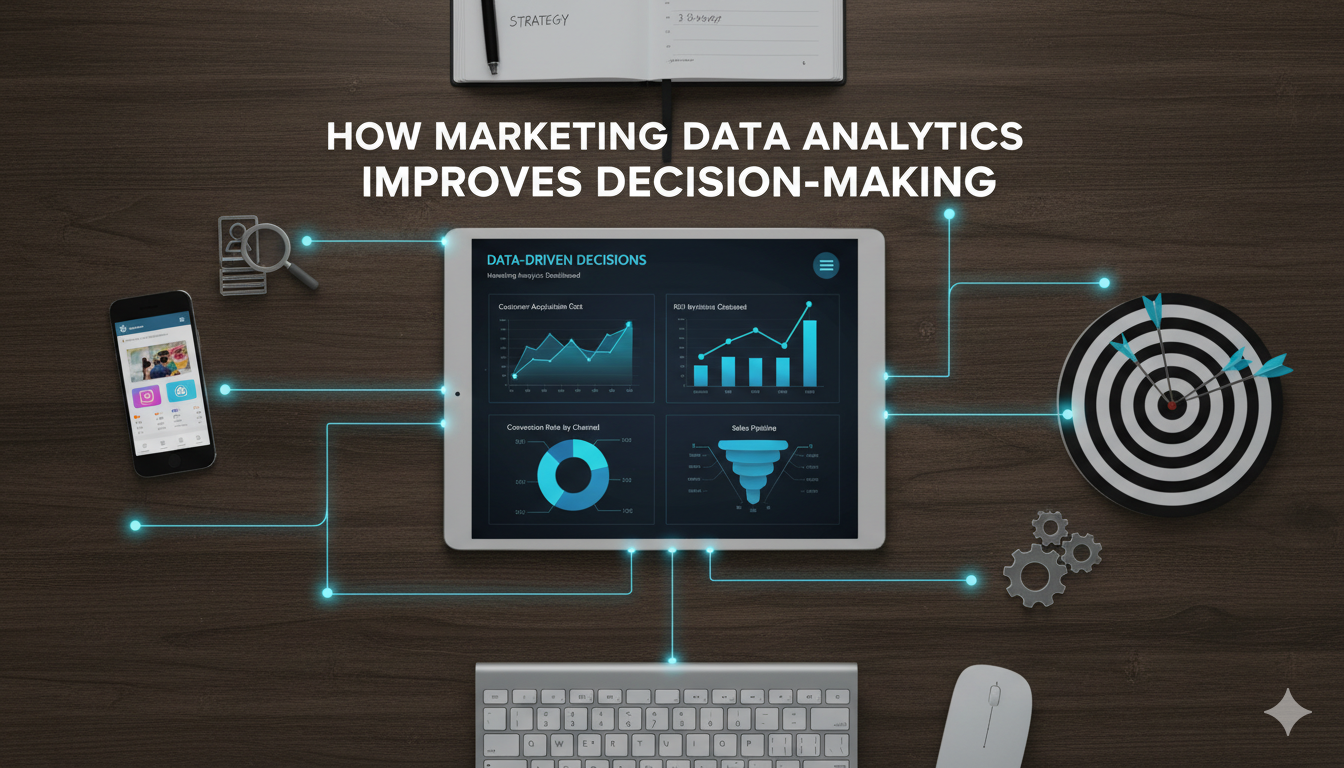
In the fast-paced world of digital business, making the right choice at the right time is the difference between growth and failure. Gone are the days when business owners had to rely on simple intuition or “gut feelings” to run their businesses. Today, every interaction a customer has with your brand produces a trail of information. At Growth Star Digital, we focus on turning that information into a roadmap for success. By using marketing data analytics, companies can gain a deep understanding of their audience. This process transforms raw numbers into clear strategies that drive profit and efficiency.
What is Marketing Data Analytics?
To truly grow, you must understand the “why” behind your results. Marketing data analytics is the practice of measuring, managing, and analyzing performance to maximize effectiveness. It is not just about looking at a spreadsheet once a month. It is about a continuous loop of gathering information from websites, social media, and email platforms to see how people behave.
When you embrace data driven marketing, you stop shouting into the void. You start listening to what your customers are actually telling you through their actions. If a customer clicks an ad but leaves the site immediately, the data tells you there is a disconnect. This level of insight ensures that every dollar spent is an investment in a proven path, rather than a shot in the dark.
Tracking Campaign Performance Metrics for Success
The only way to know if your hard work is paying off is to watch the right numbers. We call these campaign performance metrics. These are the specific indicators that tell you how a particular marketing effort is performing in real-time. For a small business, this might be as simple as tracking how many people clicked a “Contact Us” button. For a larger brand, it might involve complex multi-channel tracking.
Without strictly monitoring campaign performance metrics, you risk wasting your budget on channels that don’t work. For example, you might spend hours creating beautiful Instagram posts, but the data might show that your most profitable customers actually come from simple Google searches. By shifting your focus based on these metrics, you optimize your workflow and increase your chances of reaching your goals.
The Strategy Behind Data Driven Marketing
Moving toward a culture of data driven marketing requires a change in mindset. It means valuing evidence over opinion. In many companies, the loudest person in the room makes the decisions. However, when you use marketing data analytics, the data becomes the loudest voice. This levels the playing field and ensures that the best ideas—the ones that actually produce results—are the ones that get funded.
Using data driven marketing also allows for much higher levels of personalization. Customers today expect brands to know what they like. They want relevant suggestions, not generic noise. By studying past purchase history and browsing habits, you can create segments. These segments allow you to send the perfect message to the perfect group of people. This precision is what builds long-term loyalty in a crowded marketplace.
Improving Your ROI
The ultimate goal of every business owner is to see a healthy return on investment. Using data analytics is the most direct path to achieving this. When you have a clear view of your customer acquisition costs, you can make surgical strikes with your budget. You can identify which ads are “winners” and scale them up, while quickly cutting the “losers” before they drain your bank account.
Many businesses fail because they ignore their campaign performance metrics until it is too late. They look at their bank account at the end of the quarter and wonder where the money went. By using analytics tools daily, you catch problems when they are small. If a lead cost spikes overnight, you can pause the campaign and investigate. This agility is a massive competitive advantage that only comes from a commitment to being data-centric.
Strengthening the Sales Funnel
Every business has a “funnel” that leads a stranger to becoming a loyal customer. data analytics acts like a flashlight that helps you find holes in that funnel. You might find that you have plenty of traffic at the top, but people are getting stuck at the “add to cart” stage. This specific piece of data tells you exactly what to fix. Maybe the shipping costs are too high, or the website is too slow on mobile devices.
When you apply data driven marketing to your sales funnel, you remove friction. You make it as easy as possible for someone to give you their business. By testing different headlines, images, and button colors, you can find the perfect combination that converts. This “conversion rate optimization” is one of the most profitable uses of your time, and it is entirely fueled by the information you collect.
Mastering Campaign Performance Metrics for Long-Term Growth
Sustainable growth is built on repeatable patterns. By identifying your strongest campaign performance metrics, you find the “engine” of your business. If you know that every dollar spent on a specific keyword brings in five dollars of revenue, you have a formula for growth. You can confidently increase your spend because the data supports the move.
However, the world of digital marketing is always shifting. What worked last year might not work today. This is why you must never stop looking at your data analytics. It keeps you grounded in reality. It alerts you when a new competitor enters the market or when customer preferences begin to change. Staying ahead of the curve is only possible when you have your finger on the pulse of your data.
Simplifying Complex Information
Data can be overwhelming. There are thousands of different numbers you could track, but not all of them matter. This is why we focus on “actionable” marketing data analytics. We look for the numbers that lead to a specific change in behavior. If a metric doesn’t help you make a decision, it might just be a “vanity” metric.
Focusing on high-value campaign performance metrics—like customer lifetime value or return on ad spend—is much more useful than just looking at “likes” on a post. At Growth Star Digital, we help simplify these complex reports. We turn rows of numbers into a clear story about your business’s health. This allows you to spend less time staring at screens and more time doing what you do best: serving your customers.
The Human Element of Data Driven Marketing
It is easy to forget that every data point represents a human being. A “click” is a person showing interest. A “bounce” is a person feeling frustrated or bored. Effective data driven marketing uses these numbers to build empathy. When we see that people are leaving a page quickly, we don’t just see a low number; we see an opportunity to be more helpful and clear.
By using marketing data analytics to improve the user experience, you build trust. Trust is the foundation of every great brand. When a customer feels like a brand “gets” them, they are more likely to stay. This human-centric approach to data is what makes modern marketing so powerful. It isn’t just about selling; it’s about solving problems and meeting needs with surgical precision.
Conclusion: Making Smarter Decisions
The transition to using marketing data analytics is a journey, not a destination. It starts with a simple commitment to tracking your results. Over time, these small habits build into a powerful system that protects your business and fuels its expansion. By keeping a close eye on your campaign performance metrics, you ensure that your business remains healthy and responsive to the market.
In the end, data driven marketing is about confidence. It is the confidence to launch a new product, the confidence to enter a new market, and the confidence to invest in your future. When you have the facts on your side, the path forward becomes much clearer. The numbers are speaking—are you ready to listen?
FAQ: About Marketing Data Analytics
1. What is marketing data analytics in digital marketing?
Marketing data analytics is the process of collecting, measuring, and analyzing data from marketing channels such as websites, ads, social media, and email campaigns. It helps businesses understand customer behavior, track campaign performance, and make smarter marketing decisions based on real data rather than guesswork.
2. How does marketing data analytics improve business decision-making?
Marketing data analytics improves decision-making by showing which campaigns, channels, and strategies generate the best results. Businesses can analyze metrics like conversions, customer behavior, and return on investment to focus their budget on strategies that actually drive growth.
3. What are the most important marketing campaign performance metrics to track?
Some of the most important campaign performance metrics include conversion rate, customer acquisition cost (CAC), return on ad spend (ROAS), click-through rate (CTR), and customer lifetime value (CLV). These metrics help marketers understand how effective their campaigns are and where improvements are needed.
4. What is data-driven marketing and why is it important?
Data-driven marketing is a strategy that uses customer data and analytics to guide marketing decisions. It allows businesses to personalize campaigns, improve targeting, and increase marketing efficiency by relying on real customer insights instead of assumptions.